Key Takeaways
- The announcement of the 15th Five Year Plan (FYP) is an important event, and will contain important information. But it should not be thought of as providing a clear blueprint to a desired economic future on its own.
- The FYP forms part of a much bigger project of enunciating and explaining directions of change and goals, and establishing ways in which goals might be attained.
- The general direction of travel has typically been fairly well established before the publication of the plan itself.
- While FYPs do contain some important detail, much of the job of turning aspiration into action subsequently follows through the development of other plans, experiments and pilots.
- The way in which the FYP is announced and publicised is as much an exercise in political theatre as it is clearly defined path to a new economic future.
Introduction
The announcement of a Five Year Plan (FYP) in China is a big thing. It might not have the same visual impact as a military parade across the top of Tiananmen Square or even of keynote speeches to packed audiences at the National Party and People’s Congresses. Nevertheless, it forms one part of the grand political theatre used by the party to tell its preferred story of itself to the Chinese people, to show that it has a long term vision for what is best for China in the long run, and to persuade the people that it has the knowledge, tools and skills to be successful. In recent years, there has also been an emphasis on how this Chinese system of what is called “whole process democracy” is better than western style liberal democracies on delivering what the Chinese people need and want[1]; though telling them what they need and want is also very much part of this process too.
So the unveiling of the new 15th FYP to run from 2026 to 2030 really is important and worth studying in some detail. That said, it would be a mistake to place too much of an emphasis on the announcement of the FYP itself, or even on the specifics of its contents. To be sure, it is important to look at what is said, and in particular to focus in on specifically enunciated goals and objectives. But the plan on its own does not tell us as much about the future as we might expect. That’s why this paper does not provide an analysis of what is in the plan itself. Rather it is a paper that explains how to understand the significance of the plan (and its announcement) relative to other major policy changes, and where it fits within a broader structure of announcing and promoting goals and aspirations (and how to attain them).
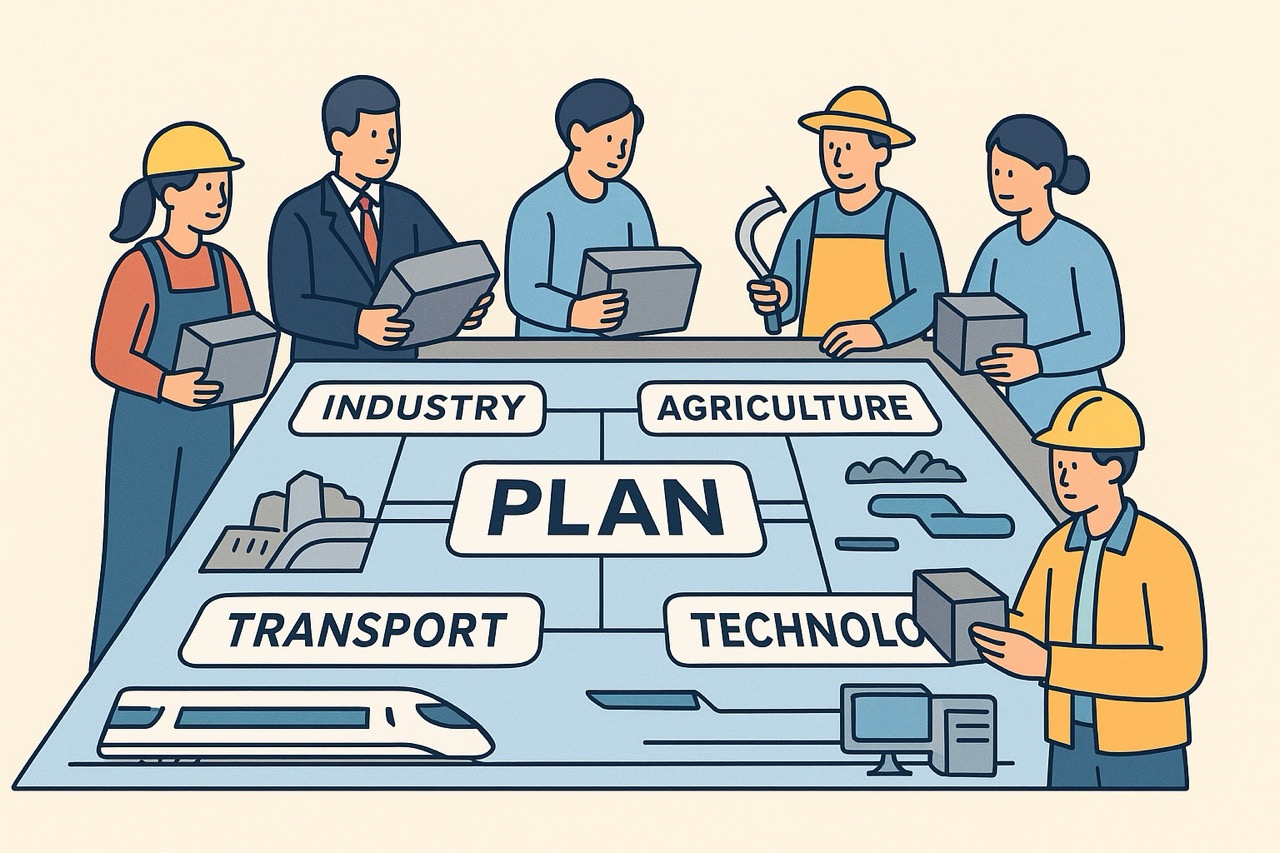
Heilmann and Melton argued that rather than think of the FYP as the single definitive document that clearly sets out the way forward for the next five years, it is best to think about a hierarchy of documents plans and announcements that collectively shape the direction of travel. Their main focus is on what happens after the Plan has been announced; the creation of what they call a “web of plans” consisting of “a network of thousands of sub-plans that evolve into detailed execution instructions for all levels of government”.[2]
But if we are thinking of layers of specificity in the way that the Chinese leadership sets its objectives and goals, we can perhaps think of a more complex hierarchy of different levels of articulation and action, with the announcement of the FYP occupying a mid-level position in this order. Each of these establishes goals and objectives, with some, but not all, also establishing ways in which these can be met. Collectively they establish the benchmarks that the party wants to be judged against as it strives to prove the effectiveness of the party and the political system in delivering what it says the Chinese people need.
As such, while studying a new FYP in detail really is a good idea, it is not enough on its own to provide a thorough understanding of the desired direction of travel. Instead, if you want to understand where the Chinese economy might be going, and what this means for the rest of the world as well as China, it is important to view it as part of a rolling and evolving set of announcements, plans and projects. Rather than taking a snapshot (as the plan is announced), the focus needs to be maintained and sustained across a much longer time period.
When is a Plan not a Plan?
It is not uncommon for the word “blueprint” to be used in discussions of the FYP. Indeed, the preamble at the start of the 14th FYP refers to itself as “a grand blueprint (hongwei lantu)”.[3] But thinking of the FYP as a very clear set of instructions that need to be followed to build something – exactly what a blueprint should be – is not really very helpful. Nor is it helpful to think back to the old FYPs (either in China or the Soviet Union) where central government officials tried to establish in some detail how goods, resources, finances and people should be allocated, priced, funded and located to attain its goals.
That’s because the FYP is actually not really a plan as such all. If it was ever possible to control everything that happens in the Chinese economy through a planning agency in Beijing, it certainly is not possible today. To be sure, under Xi Jinping the private sector has been placed under closer scrutiny and control. The central leadership also possesses a number of tools to not just shape what others do, but also to be an economic actor and directly involved in economic interactions itself. Even so, the Chinese economy is simply too big with too many (diverse) actors pursuing different goals for it to be run by administrative fiat. That is why just before describing itself as a blueprint, the 14th FYP established that “It mainly clarifies the country's strategic intentions, clarifies the government's work priorities, and guides and regulates the behaviour of market entities.” So not really a blueprint at all. Much of the detail on how to turn aspiration into action comes later; and sometimes quite a while later.
| Box 1. |
|
It is no easy task to understand how the Chinese economy actually works. And in many respects it is foolish to try to provide a concise overview and explanation. But this is exactly what I try to do in a short online lecture for EH4S’s sister project, ReConnect China. Here I place specific emphasis on the state’s control over the Chinese financial system, but also look at the relative importance of pricing and price controls; what State Owned Enterprises do in both shaping market action and being market actors themselves (including those owned by local governments); the disguised nature of state ownership in many companies; and the role of local governments more generally in shaping local economic activity (not least through their ownership of land). This culminates in the diagrammatic depiction at the end of this paper to what I call a state-guided market economy. The whole lecture is available open access at https://www.youtube.com/watch?v=P9WClZmHCuI with an explanation of the diagram starting at 18 minutes and 53 seconds. |
Nor is the FYP intended to represent a clear break with the past and mark the start of an entirely new era. Once again, studying the specifics is important. For example, identifying what is a binding target that officials simply must attain, and what is an anticipated target tells us a lot about different degrees of priority and significance amongst the many different elements of the plan.[4] At the headlines level, though, the plan is not intended to suddenly introduce new priorities out of the blue. The big picture ambition will have already been established and presented by the leadership. More than that, establishing the grand ambition provides the very framework that those who develop the details of the plan have to work within (and work towards attaining). In addition, in the period before the announcement of the plan itself – for about a year to 18 months before its formal adoption – leaders and the media will discuss and highlight key elements of what it will contain.
The plan, then, is not the first word. Rather, it puts flesh on a pre-existing skeleton. It is not the final word either. To stretch the skeleton metaphor, it needs to then be filled with all the organs, muscles, fluids and so on to make it a fully functioning body. Rather that extend this metaphor any further to its breaking point, it is probably best to more simply establish where the plan fits in the leaderships’ hierarchy of methods and mechanisms of establishing its goals.
Hierarchies of Authority
Establishing the big picture
At the very top of the is the primary or principal contradiction; or more correctly, a change in the principal contradiction. This represents a very rare and highest level of change when it comes to establishing the party’s main task and framing and explaining its new objectives and goals. As outlined in the very first EH4S publication,[5] this entails identifying the single most important challenge to the party and the political system and explaining why it has changed. Once this has been done, it then justifies doing whatever it takes to deal with the contradiction and prevent it from becoming an existential challenge to party rule as “left unsolved, it can lead to chaos and eventually, as Marx predicted, to revolution”.[6] It also justifies why it is now right to leave previous priorities and policies behind; and maybe even to overturn them.
Shifting the principal contradiction from the need to fight and win a class war for much of the Mao period to the urgency of dealing with China’s lack of development under Deng opened the door for doing whatever it took to generate that growth and development. This remained the starting point of policy making for three and a half decades until Xi Jinping’s designation of a new principal contradiction in 2017; “that between the ever-growing needs of the people for a better life and unbalanced and inadequate development”. In shifted the focus from simply the quantity of growth to the quality and utility of growth, Xi was signalling the start of a “new era” that stood in contrast to the modifications and changes within the existing framework that other post-Deng leaders had made.
The second layer of the hierarchy entails establishing big picture concepts to give a bit more flesh and depth to what the party is now trying to do, whilst maintaining a relatively high level of generalisation and a rather low level of specificity. In the current era, examples include Xi’s promotion of “High Quality Development” and the drive to develop “new Quality Productive Forces”. We covered the meaning of these concepts in detail in a 2024 EH4S paper, so won’t repeat them here.[7] In general, they both individually and collectively focus on moving on from an era where growth was largely based on an increase in either labour or capital (or both) to one where growth is created by technological progress and innovation. Its about moving up the value chain in all forms of economic activity, and worrying less about the size of the economic (growth for growth’s sake) and concentrating on quality instead.
Getting detailed
The third layer entails setting the scene in advance of the Plan’s announcement. This includes the reporting of the various preparatory meetings as the Plan is being developed, and what key leaders (most notably Xi himself) say about what the Plan should include. In the run up to the 15th Five Year Plan, these collectively emphasised the importance of innovation, inclusive growth and economic resilience.[8] The importance of boosting domestic consumption was also frequently in the news, and can be seen both as an end in itself, and also a means of attaining the other three goals (to different degrees).
The same is probably true when it comes to the increased use of the concept of combatting “involution” in 2025 (often referred to as an anti-involution policy), where over capacity and supply leads to “excessive and self-defeating competition among Chinese companies for limited resources and opportunities” resulting in “diminishing returns, overproduction and fierce price wars”. It is a problem that needs to be dealt with in its own right to solve immediate and present problems, but also to establish the basis for necessary structural change in the future.[9]
The repeated emphasis on the importance of “creating a unified national market” might also sit in this category of objective. This includes both general aspirational statements, and also more specific plans, like the announcement of pilot projects to promote “market-based allocation of production factors” in September 2025.[10] That said, given how long Xi has been talking about the need to “break local protectionism and administrative monopolies”, it perhaps occupies a special position on its own in a ranking of objectives.[11]
The fourth layer is the Plan itself. Here, it perhaps helps to think of the importance of the Plan as not just lying in not just what it contains, but also in the way that it is presented and reported. As noted in the introduction, this provides the basis for one of the grand acts of political theatre than the Chinese political system specialises in.
From aspiration to action (sort of)
The fifth and final layer is the wide range of geographic and/or sectoral plans that are then subsequently developed to turn aspiration into outcome; Heilman and Melton’s “web of plans” which evolve throughout the term of the FYP. For example, as Stanford University’s Digichina explain, following the 14th FYP, the Central Commission for Cybersecurity and Informatization produced their own plan outlining what they would be doing to explain how they are going to deliver their part of the big vision. This has much more detail than the FYP itself, outlining five main target areas; General Development Levels, Digital Infrastructure, Innovative Capabilities, Industrial Transformation and Government Services. With the exception of the first category, the other four are then broken down into more specific goals, each with their own measurable performance indicators. In Digital Infrastructure, for example, there are specific targets for increases in the number of netizens, the percentage of 5g users, the number of high speed optical users, and the number of users of the newest internet protocol (IPv6).[12]
Even in documents like this, though, there remains a considerable degree of aspirational lack of specificity. Varieties of the word “promote” appear 362 times in what is admittedly a fairly lengthy document, “strengthen” 332 times “accelerate” or “accelerating” 216 times, and “deepen” 74 times. And although sources of funding are referred to in the plan, it is very much not specific on how much money will be spent (or where it will come from) to meet its objectives. Even this document, then, should be thought of as a work in progress that needs subsequent further refinement and detailing.
Conclusions
The digital plan was just one of the many different plans and projects that were developed to try and turn the ambitions of the 14th FYP into something more concrete; though have we have seen, something that was not always in itself that concrete and detailed. And one quick conclusion of this short discussion is that given the amount of sectoral and regional plans and numerous different types of experimental pilot projects, it is all but impossible for a single individual to have a firm grasp on what is going on in every part of the economy. And certainly simply focusing on what is said in a FYP is not going to provide a fine grained understanding of the specific direction of travel across the country and economy as a whole. The plan does, though, do a good job in providing an overview of what the leadership wants to do and where it wants to go. And as already noted, it provides a very good guide to the relative importance of different goals through the differentiation of types of targets.
It is not surprising that the announcement of a new FYP gets so much attention. After all, this is exactly what the CCP wants to happen. Xi Jinping is attempting to engineer a rather fundamental shift in the nature of the Chinese economy. In addition to being an enormous economic task, this is also a massive political job as well as the party shifts part of the way in which it tries to legitimate one-party rule.
The plan, then, forms an important part of what Rigby called the search for “goal rational legitimacy” in Communist Party states[13]; but which is latterly more often referred to as “performance legitimacy”. This revolves around the idea that doing things well might not be enough on its own to gain approval, support and legitimacy. The key is to make sure that the people know that you have done something well. The best way of doing this is to use the propaganda apparatus to explain what your goals are, and why you are seeking to attain these on behalf of the people. And then have another campaign to later explain how well you have done in attaining these goals (and once more, for the good of and on behalf of the people). Or even better, as Rigby argued, to show that you have exceeded the original goals or attained them ahead of schedule; or both.
What all this means is that the FYP does indeed need to be studied for what it tells us about likely future trajectories. But rather than thinking of it as just an economics document, its political significance as an act of signalling its performative function should also be taken into account. And rather than thinking of it as the single key document – the blueprint – for future change, it should instead be thought of as constituting one part of a much longer chain, with much of the job of working out exactly what to do in specific regions and sectors still waiting to be done.

Figure 1: The State Guided Market Economy

 | Co-funded by the European Union. Views and opinions expressed are however those of the author(s) only and do not necessarily reflect those of the European Union or European Research Executive Agency (REA). Neither the European Union nor the granting authority can be held responsible for them. |
[1]Jean-Pierre Cabestan, “Xi Jinping and China’s whole-process democracy: A new form of consultative Leninism”, China Information, 2025, available online first at 10.1177/0920203X251361713 last accessed 12th September 2025.
[2] Although this was published over a decade ago, it remains very useful for those trying to understand how guidance and planning cascades through the Chinese political system from top to bottom. Sebastian Heilmann and Oliver Melton, “The Reinvention of Development Planning in China, 1993–2012”, Modern China, 39 (6) 2013, pp. 580-629. This quote is on p.585.
[3]“Zhonghua renmin gongheguo guomin jingji he shehui fazhan di shisi ge wu nian guihua he 2035 nian yuanjing mubiao gangyao (Outline of the 14th Five-Year Plan for National Economic and Social Development of the People's Republic of China and the Long-Term Objectives for 2035)”, available at https://www.gov.cn/xinwen/2021-03/13/content_5592681.htm last accessed 1st September 2025.
[4] Binding targets are those that have to be met, as opposed to anticipated ones which provide a more vague expectation of where the country will be in five years time. These binding targets form part of the evaluation system that all Chinese officials are subject to. if those responsible for attaining these binding targets - for example, local officials in their jurisdiction or officials in specific ministries and agencies – then they will have deemed to have failed even if they have met all of their other targets and responsibilities.
[5] Shaun Breslin, “The ‘Two Integrations’ And The (Increasing) Chineseness of Chinese Marxism”, 25th March 2024, available at https://eh4s.eu/publication/The-Two-Integrations-And-The-Increasing-Chineseness-of-Chinese-Marxism last accessed 4th August 2025.
[6] “China embraces new ‘principal contradiction’ when embarking on new journey”, Xinhua, 20th October 2017, available at http://www.xinhuanet.com/english/2017-10/20/c_136694592.htm last accessed 13th February 2024.
[7] Shaun Breslin and Ren Xinyuan, “What’s New About China’s New Quality Productive Forces?”, 18th June 2024, available at https://eh4s.eu/publication/whats-new-about-chinas-new-quality-productive-forces last accessed 4th August 2025.
[8] For a representative example, see “Five Year Plans Chart Steady Progress”, China Daily, 27th June 2025, available at https://www.chinadaily.com.cn/a/202506/27/WS685dce2da310a04af22c8bdb.html last accessed 1st July 2025.
[9] Chi Lo, “China – Involution, deflation and structural reform”, BNP ViewPoint, 11th August 2025, available at https://viewpoint.bnpparibas-am.com/china-involution-deflation-and-structural-reform last accessed 19th August 2025.
[10]Xinhua, “China announces 10 pilot projects on reforms of market-based allocation of production factors”, 11th September 2025, available at https://english.news.cn/20250911/d83d736500734f219ca313a1b82871a5/c.html last accessed 12th September 2025.
[11] This specific quote is taken from Xi’s speech at the Party Congress in 2022, available at https://www.idcpc.org.cn/english2023/tjzl/cpcjj/20thPartyCongrssReport/ last accessed 14th March 2024. For more details of the longer term objective, see Stanley Wu, “China’s Unification from Within: Dismantling Local Protectionism”, CSIS, 23rd January 2024, available at https://www.csis.org/blogs/new-perspectives-asia/chinas-unification-within-dismantling-local-protectionism last accessed 23rd July 2024.
[12] Digichina, “Translation: 14th Five-Year Plan for National Informatization – Dec. 2021”, 24th January 2024, available at https://digichina.stanford.edu/work/translation-14th-five-year-plan-for-national-informatization-dec-2021/ last accessed 4th August 2025.
[13] Rigby, T.H. (1982). “Political Legitimacy. Weber and Communist Mono-organizational Systems: in T.H. Rigby and F. Fehér (eds)., Political legitimation in Communist States (London: Macmillan, 1982): pp. 1-26.