
Key takeaways
- The joint adoption of the term ‘constructive strategic stability’ after the May 2026 US–China summit revealed a shared recognition in Beijing and Washington that competition must be managed within a framework of limited stability, to allow both powers to pursue their domestic priorities while avoiding the costs of uncontrolled confrontation.[1]
- The summit did not alter the legal or institutional foundations of US policy towards Taiwan, but Trump's rhetoric and diplomatic priorities in other parts of the world may have encouraged China's strategic community to reassess Washington's willingness to shoulder the costs of direct military intervention.
- The domestic priorities of both countries will ultimately determine the sustainability of constructive strategic stability. For the US, these are centred on the cost of living and Washington’s military adventures in the Middle East. For China, the focus is on buying time to build technological self-reliance and to deliver the core elements of the 15th Five-Year Plan.
Introduction
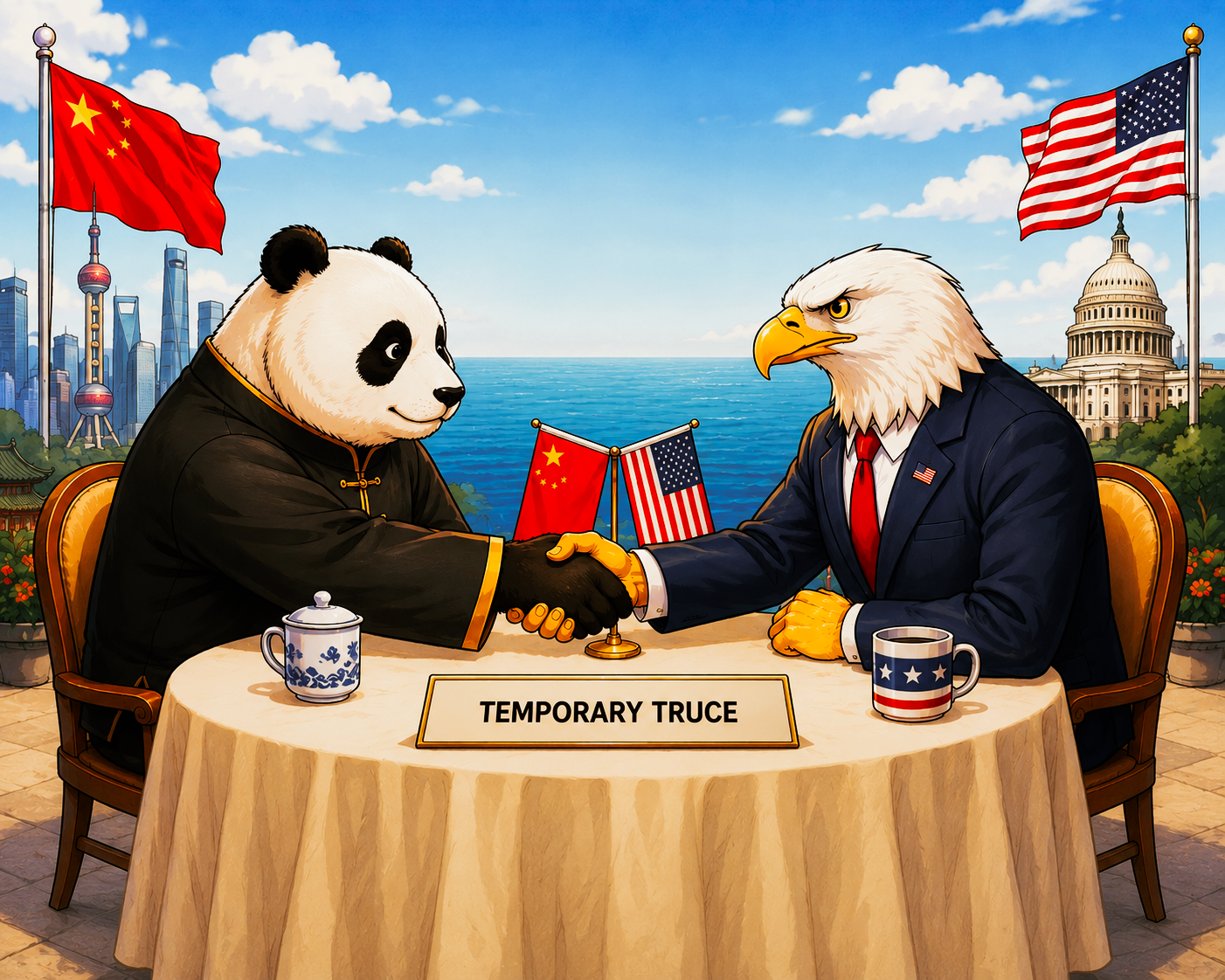
On 14 May 2026, when Chinese President Xi Jinping met his American counterpart, President Donald Trump, he introduced the concept of ‘constructive strategic stability’ to describe the current state of the world's most consequential bilateral relationship.[2] Since then, policymakers, analysts and commentators have debated both the meaning of the term and the sustainability of the framework it represents. With more than two years remaining for the current US administration, Beijing and Washington appear to have reached a tentative truce, with both sides seeking limited stability in a relationship that remains fundamentally competitive.
Many international observers have closely scrutinized the details of the May summit in search of concrete agreements or broader bargains concerning trade, Taiwan and crisis management. However, in the view of some Chinese observers, the summit produced a form of constructive ambiguity while signalling that Washington has finally begun to treat Beijing as a strategic peer and equal. [3]
Even so, few would argue that Sino-American relations have returned to the earlier era of ‘engagement’ pursued by successive American administrations before the end of the Obama presidency.[4] Instead, the summit appears to have established a new middle ground, defined by managed competition and an implicit recognition that neither side can afford the costs of unrestrained confrontation.
Global pundits, policy practitioners and investors have devoted considerable attention to the May Trump–Xi summit, analysing its implications for trade, security competition and the broader trajectory of US–China relations. Yet relatively little has been written about how China’s strategic community has interpreted the concept of ‘constructive strategic stability’ and assessed the near-term direction of the bilateral relationship.
This policy paper presents the author’s own assessment of the current state of bilateral relations, with references to the views, public statements and speeches of selected Chinese officials and influential experts following the summit. In doing so, it aims to complement the debate among western scholars over the current trajectory of China-US relations and provide an inside-out understanding of Beijing’s expectations to Washington in the months ahead. The evolving dynamics of this bilaterial tie and potential recalibration of the transatlantic alliance will have long-lasting implications for the rest of the world, including the EU and the UK.
The emergence of ‘constructive strategic stability’
One of the most significant yet underappreciated outcomes of the May 2026 Trump–Xi summit was the joint adoption of the phrase ‘constructive strategic stability’ to describe the future direction of US–China relations. Yet, international pundits have queried how ‘constructive’ it will be and for how long the ‘stability’ will hold, given President Trump’s erratic approach to diplomacy. It will take two to tango in maintaining these very consequential bilateral ties.
While President Xi introduced the concept during the summit, its significance lies in the fact that the White House subsequently echoed almost identical language in its official fact sheet, stating that both leaders had agreed to ‘build a constructive relationship of strategic stability on the basis of fairness and reciprocity.’[5] This represents the first time in years that Washington and Beijing have publicly converged on a common description of their bilateral relationship, even if they continue to interpret that description differently. Without over-emphasizing this term, such a convergence in diplomatic vocabulary is rare.
From Beijing's perspective, strategic stability extends far beyond the traditional nuclear realm as a Chinese arms control specialist referred.[6] Chinese analysts generally define stability in comprehensive terms, encompassing military competition, economic interdependence, technological rivalry, crisis management and mutual political recognition.[7] The addition of the adjective ‘constructive’ further implies that competition should be bounded by agreed rules and directed towards coexistence, rather than outright confrontation.[8]
Seen in this light, the phrase itself is not entirely new. Chinese officials and scholars have long advocated concepts such as a ‘new type of major-country relationship’, ‘mutual respect’, and ‘peaceful coexistence’, all of which emphasize the need to manage strategic competition while avoiding direct confrontation.[9] Constructive strategic stability should therefore be understood less as a completely new doctrine and more as an evolution of Beijing's longstanding diplomatic narrative, adapted to a geopolitical environment in which protracted rivalry with the United States has become the defining feature of the relationship.
What is genuinely new is Washington's willingness to publicly employ terminology that closely resembles Beijing's preferred framing. This should not be interpreted as a straightforward US endorsement of China's broader vision for the international order. The White House's formulation deliberately qualifies the concept by stressing that strategic stability should rest on ‘fairness and reciprocity’, language that reflects enduring American concerns over market access, trade practices and the balance of obligations between the two countries.[10]
In other words, both governments have utilized the same diplomatic vocabulary, but they continue to attach different strategic meanings to it.[11] For Beijing, the concept is primarily about securing mutual recognition of China's status as an equal great power and establishing redlines against confrontation. For Washington, it is a pragmatic framework for managing competition while preserving American leverage and advancing US interests.
The importance of this rare convergence in wording should therefore not be overstated, but neither should it be dismissed. Rather than signalling a return to the era of engagement, the joint adoption of constructive strategic stability reflects a shared recognition that neither side can afford an uncontrolled deterioration in bilateral relations. The phrase establishes a consensual vocabulary through which both governments can pursue selective cooperation, manage crises and contain strategic competition without resolving their fundamental differences.
Neither ‘Chi-merica’ nor intense confrontation – for now
Putting the optics and diplomatic rhetoric aside, the clearest conclusion arising from the summit is that the US–China relationship is moving into an entirely different phase.
Over the past decade, US–China relations have gone through a dramatic cycle of ups and downs. The first Trump administration decisively abandoned the long-standing policy of engagement, replacing it with bipartisan consensus on strategic competition, tariffs and an ultra-confrontational approach towards Beijing. The Biden administration largely preserved this competitive framework, expanding technology controls, strengthening alliance coordination in the Indo-Pacific and framing China as America's principal long-term strategic and ideological nemesis. It also sought to establish so-called ‘guardrails’ to prevent the relationship from descending into open conflict, but these were largely dismissed by Beijing.[12]
Against this backdrop, the May 2026 Trump–Xi summit suggests that both governments are moving beyond the extremes of either engagement or unrestrained confrontation towards a more pragmatic, if fragile, mode of co-existence.
Neither Washington nor Beijing appears willing to restore the dense forms of interdependence that once defined the relationship. American concerns regarding supply chains, technological leadership and national security remain deeply entrenched. Likewise, Chinese leaders remain committed to technological self-reliance, industrial manufacturing superpower and greater insulation from external pressures.
At the same time, however, the summit demonstrated that neither side wishes to sustain the exceptionally high levels of confrontation that became the recurring theme during recent years. Tariff disputes, technological restrictions, military signalling and ever-hostile rhetoric imposed substantial costs upon both countries.
The result is a paradoxical arrangement. Both countries continue to regard each other as strategic competitors, yet they increasingly behave as competitors who recognize that unrestricted confrontation is ultimately self-defeating.
Such a model differs fundamentally from both Cold War bipolarity and the earlier period of engagement. It is driven instead by selective cooperation, managed competition and limited mutual accommodation. A leading Chinese scholar suggested that ‘the May summit has led the world order into some kind of dual-cores multipolarity’.[13]
This development also reflects President Trump's distinctive approach to diplomacy. Unlike Washington political establishments that frame competition primarily in ideological terms, Trump has consistently demonstrated a preference for transactional bargaining, highly personalized negotiations and visible political outcomes. President Xi, meanwhile, appears equally interested in establishing a predictable point of contact and face-to-face meetings that reduce the likelihood of uncontrolled escalation.
The May summit therefore represents not a reconciliation, but a nascent recalibration between the two capitals – at least under the current Trump administration.
Beijing's strategic assessment of American political commitment to Taiwan
In the aftermath of the May summit, the US strategic community intensely debated whether President Trump has changed the long-standing US commitment to Taiwan. Influential scholars in China had a similar debate among themselves.[14]
No single topic illustrates the complexities of the latest recalibration of the US–China relationship more clearly than Taiwan. The summit readout from Beijing dedicated a significant number of words to laying out the critical nature of the Taiwan question in the overall bilateral relationship.[15]
Although the summit produced no fundamental deviation in the official US policy, discussions nevertheless highlighted subtle, but potentially consequential, shifts in the American position. President Trump reaffirmed the importance of peace and stability across the Taiwan Strait, while simultaneously emphasizing broader priorities, including economic recovery, market stability and great-power diplomacy.[16]
Such statements have reinforced the perception that Trump views Taiwan not as an ideological commitment but as one element within overall great-power relationship management.
This perception is not entirely new. Throughout both of his presidencies, Trump has frequently demonstrated scepticism regarding long-term security commitments that, in his view, impose disproportionate costs upon the United States.[17]
Beijing may therefore conclude that opportunities for diplomatic accommodation have expanded. Chinese leaders are likely to interpret the summit as a clear signal that President Trump places greater emphasis on avoiding direct military confrontation than on demonstrating American resolve over Taiwan. Such an assessment would be consistent with Trump's broader preference for reducing overseas security commitments that he considers expensive, while prioritizing economic bargaining and great-power diplomacy.
Several Chinese commentators have interpreted Trump's remarks in precisely these terms. In their view, Taiwan is no longer treated primarily as a litmus test of American credibility in the Indo-Pacific, but increasingly as one issue within the broader management of US–China relations.[18] From this perspective, Trump appears to view Taiwan through a transactional lens: direct military involvement across the Taiwan Strait would not only impose significant strategic and financial costs on the United States, but could also jeopardize his broader objectives of stabilizing relations with Beijing and reducing America's long-term alliance burdens.
This interpretation does not necessarily imply that the US has fundamentally abandoned its long-standing Taiwan policy.[19] Existing legislation, Congress and the wider US national security establishment continue to shape presidential decision-making and preserve elements of strategic continuity.
Nevertheless, Beijing's assessment of American intentions is unlikely to be driven solely by formal policy statements. Chinese analysts generally place considerable emphasis on the political preferences and negotiating style of individual US presidents. Consequently, if influential Chinese observers increasingly conclude that Trump is less inclined than previous administrations to employ military force in defence of Taiwan, this perception alone could reshape Beijing's assessment of American political resolve.
The significance of the May summit therefore lies less in any formal policy adjustment than in the signals it conveyed. Even without altering the legal or institutional foundations of US policy towards Taiwan, Trump's rhetoric and diplomatic priorities in other parts of the world may have encouraged a reassessment within China's strategic community of Washington's willingness to burden the costs of direct military intervention. Such changes in perceived political will can be as consequential for deterrence as closing gaps in the two militaries’ capabilities.
Domestic imperatives and political incentives
The timing of the summit was equally illuminating. Both leaders face powerful domestic incentives to pursue a more stable relationship, even as strategic competition continues. In Washington, concerns over war in the Gulf, the cost of living and financial market stability have reinforced the grassroots political appeal of temporarily reducing tensions with China. At the same time, President Trump has consistently preferred high-octane leaders’ meetings that can be presented as evidence of powerful leadership and successful bargaining.
China's calculations appear to be shaped by a different set of considerations. Rather than responding solely to cyclical economic pressures, Beijing is increasingly focused on the long-term objectives outlined in its latest Five-Year Plan.[20] Chinese policymakers appear prepared to accept a slower pace of growth in exchange for deeper structural transformation, including technological supremacy and greater self-reliance in strategically important sectors. Achieving these objectives will require not only substantial financial resources and sustained state investment, but also a relatively predictable external environment.[21]
For Beijing, prolonged strategic confrontation with the United States would complicate this transition. Intensified geopolitical competition would divert resources towards short-term crisis management, increase uncertainty for domestic industries and expose China to additional external pressure.[22] A more stable relationship with Washington, even if only temporary, would therefore provide the leadership with greater strategic space to pursue its long-term economic objectives.
One of the most esteemed Chinese strategists consequently argued that Xi is seeking to take advantage of what may be a limited political window while Trump remains in office.[23] Their assessment is not that Beijing expects a fundamental reconciliation with Washington, but rather that it hopes to establish sufficient stability to facilitate China's own economic and technological transformation. Constructive strategic stability is therefore not an end in itself, but a means of creating more favourable conditions for the next stage of China's development.
Political considerations are equally important. Trump has long emphasized the value of personal diplomacy and has consistently portrayed himself as a leader capable of reaching agreements that others could not. He views Chinese policies as serving the purpose of the summit, not vice versa. Xi, meanwhile, has sought to project an image of confidence and stewardship. In this sense, both leaders have incentives to portray stability not as a concession to the other side, but as a demonstration of their own leadership and political authority.
Wider policy implications
There are several wider implications emerging from the May summit. To start with, international policymakers should avoid interpreting the language of constructive strategic stability as evidence of a fundamental strategic transformation. Competition remains the defining feature of the relationship.
As with all of President Trump’s comments, observers should distinguish carefully between symbolic rhetoric and substantive policy adjustments from Washington. Public language could change rapidly after the May summit, while strategic interests tend to evolve much more gradually.
As always, Taiwan will remain a critical source of instability. Even relatively modest changes in perceptions of American commitment could produce disproportionate strategic responses from Beijing and other powers in the region.
The central conclusion of the summit is that both Washington and Beijing increasingly recognize the necessity of coexistence. Neither side appears willing to surrender its fundamental objectives, yet neither appears prepared to bear the costs of unlimited confrontation. The world is therefore witnessing the emergence of a new equilibrium: a relationship that is neither cooperative enough to resemble the age of engagement, nor hostile enough to constitute a new Cold War. The concept of constructive strategic stability reflects precisely this ambiguous reality.
Whether such a balance can endure will depend not only on warm words from both Presidents, but also on the ability of both leaders to reconcile domestic political pressures with the incentives of great-power management. The three meetings scheduled for the rest of 2026 will provide an early indication of whether this delicate equilibrium can be maintained. They will serve as signposts on whether constructive strategic stability can evolve from a rhetorical formula into a durable framework.
Conclusion
The scheduled state visit by President Xi to the US in late September will be expected to implement understandings reached during the May summit. Both sides will focus on the concrete delivery of two boards of trade and investments respectively, export controls, military communication and mechanisms designed to prevent crises from escalating unexpectedly.
The May 2026 Trump–Xi summit did not mark the return of engagement, nor did it signal the end of strategic competition. Instead, it revealed a shared recognition in Beijing and in Washington that competition must be managed within a framework of limited stability, one that allows both powers to pursue their domestic priorities while avoiding the costs of uncontrolled confrontation. To borrow a phrase from a report written by one of China’s most influential think tanks, ‘strategic stalemate defines the current state of China–US relations’ – but the question without a clear answer is, for how long?[24]

 | Co-funded by the European Union. Views and opinions expressed are however those of the author(s) only and do not necessarily reflect those of the European Union or European Research Executive Agency (REA). Neither the European Union nor the granting authority can be held responsible for them. |
| UK participants in Horizon Europe Project European Hub for Contemporary China are supported by UKRI grant numbers 10108183 and 10108749. |
[1] The author would like to thank a number of scholars’ thoughtful comments during the drafting process.
[2] Xinhua (2026), ‘Xi holds talks with Trump in Beijing’, Xinhua, 14 May 2026, https://english.news.cn/20260514/b61c0bab915041b68afc48568c9a1e1d/c.html.
[3] Jia, Q. (2026), ‘中美峰会:成果、历史定位及两国关系走向’ [China-US summit: results, historical positioning and trajectory of bilateral ties], China US Focus, 26 May 2026, https://cn.chinausfocus.com/foreign-policy/20260526/44314.html The author is former Dean at School of International Studies, Peking University.
[4] Gao, F. (2026), ‘以建设性战略稳定构建新时代中美关系’ [Build Sino-US relations in the new era based on constructive strategic stability], Qiu Shi, 27 May 2026, https://www.qstheory.cn/20260527/635dfe14f523488bad61fe8f0184d272/c.html.The author is Dean of Foreign Affairs University and former Deputy Director General of U.S. and Canada Bureau at PRC Ministry of Foreign Affairs.
[5] The White House (2026), ‘President Donald J. Trump secures historic deals with China, delivering for American workers, farmers, and industry’, press release, 17 May 2026, https://www.whitehouse.gov/fact-sheets/2026/05/fact-sheet-president-donald-j-trump-secures-historic-deals-with-china-delivering-for-american-workers-farmers-and-industry.
[6] Wu, R. (2025), ‘吴日强: 核威慑与战略稳定的深层逻辑’ [Expert perspective: the entrenched logic of nuclear deterrence and strategic stability], Military Digest via Chinese Institute of Command and Control, 28 May 2025, https://www.c2.org.cn/h-nd-2157.html.
[7] Zhao, M. (2026), ‘赵明昊: “特朗普访华探索中美关系” 战略稳定”新路径’ [Trump’s visit to China explores the path to ‘strategic stability’ between China and the US’, Lianhe Zhaobao, 10 May 2026, https://www.zaobao.com.sg/forum/views/story20260510-9026478.
[8] The PRC State Council (2026), ‘China's top diplomat expounds on new vision of China–US relations’, 15 May 2026, https://english.www.gov.cn/news/202605/15/content_WS6a073b9ac6d00ca5f9a0b00b.html
[9] The PRC MFA (2020), ‘杨洁篪署名文章:尊重历史面向未来, 坚定不移维护和稳定中美关系’ [Yang Jiechi: Respecting history, looking forward and resolutely maintaining and stabilizing Sino-US relations], Speech, Yang Jiechi, member of the political bureau of the CPC Central Committee and director of the Office of the Central Foreign Affairs Commission, 7 August 2020, https://www.mfa.gov.cn/web/gjhdq_676201/gjhdqzz_681964/lhg_683142/zyjh_683152/202008/t20200807_9389875.shtml.
[10] The White House (2026), ‘President Donald J. Trump secures historic deals with China, delivering for American workers, farmers, and industry’.
[11] Liu, Z. (2026), ‘China and the US agreed to “strategic stability” in Beijing. They don’t define it the same way’, Council on Foreign Relations, 18 May 2026, https://www.cfr.org/articles/china-and-the-u-s-agreed-to-strategic-stability-in-beijing-they-dont-define-it-the-same-way.
[12] Chen, Q. & Bai, Y. (2023), ‘If China-US relations are already on the wrong track, what use US-proposed ‘guardrails’ are: former Chinese ambassador’, Global Times, 3 July 2023, https://www.globaltimes.cn/page/202307/1293618.shtml.
[13] Da, W. & Zhou, W. (2026), ‘探寻建设性战略稳定: ‘双核多极’时代的中美关系’ [Exploring ‘constructive strategic stability: China–US relations in an era of “dual cores multipolarity”, ‘现代国际关系Contemporary International Relations, Issue 5, 2026, https://ciss.tsinghua.edu.cn/info/zmgx/9282.
[14] CRNTT (2026), 双C论坛:中美新定位下的台海局势展望 CRNTT&CISS Tsinghua University Double-C Forum: an outlook on the cross-strait situation under a new framework for China-US relations], 22 June 2026, http://www.crntt.tw/touch/detail.jsp?coluid=5&kindid=0&docid=107204838.
[15] Xinhua (2026), ‘Xi holds talks with Trump in Beijing’.
[16] Roll Call (2026), ‘Interview: Bret Baier Interviews Donald Trump in Beijing for Fox News – May 15, 2026’, https://rollcall.com/factbase/trump/transcript/donald-trump-interview-bret-baier-fox-news-beijing-may-15-2026.
[17] Bush, R. & Hass, R. (2024), ‘How would the Trump or Harris administration approach Taiwan?’, Brookings Institution, 3 October 2024, https://www.brookings.edu/articles/how-would-the-trump-or-harris-administration-approach-taiwan.
[18] Shao, Y. (2026), ‘邵育群:美威慑保台逻辑未变,博弈面临挑战’ [Shao Yuqun: the US has not changed the deterrence logic related to Taiwan, which will continue to challenge China-US ties], Shanghai Institute for International Studies, 25 June 2026, https://finance.sina.com.cn/wm/2026-06-25/doc-inierihu5731893.shtml; Li, C. (2026), ‘美越推台非對稱戰力越顯控局乏力’ [Interview with Li Chen: the more the US pushes for strengthening asymmetric warfare capabilities to Taiwan, the less the US is able to control the situation across the Strait.”, China Review News, 8 August 2026,http://www.crntt.tw/touch/detail.jsp?coluid=1&kindid=0&docid=107221228 The interviewee is a Chinese leading military strategy scholar covering US-China competition.
[19] Xinhua (2026), ‘Xi holds talks with Trump in Beijing’.
[20] Yu, J. (2026), ‘China’s Five-Year Plan commits to economic resilience – as the Iran war exposes the fragility of global supply’, Chatham House Expert Comment, 13 March 2026, https://www.chathamhouse.org/2026/03/chinas-five-year-plan-commits-economic-resilience-iran-war-exposes-fragility-global-supply.
[21] Yu, J. (2026), ‘China first: as Trump meets Xi, how Beijing sees the world now,’ Time, 13 May 2026, https://time.com/article/2026/05/13/china-first-trump-xi-beijing-summit.
[22] Yu J. (2025), ‘Three lessons China learnt from the United States’, Foreign Policy, 11 December 2025, https://foreignpolicy.com/2025/12/11/lessons-china-learned-superpower.
[23] Wang, J. & Lampton, D. (2026), ‘America and China at the edge of ruin’, Foreign Affairs, 12 February 2026, https://www.foreignaffairs.com/united-states/america-and-china-edge-ruin-lampton-jisi People’s Daily (2026), ‘中美关系回不到过去,但能够有一个更好的未来——写在中美元首会晤之际[Relations between China and the US will not return to the past, but they could have a better future – ahead of leaders’ summit between the two countries], Editorial by People’s Daily, 13 May 2026, https://paper.people.com.cn/rmrb/pc/content/202605/13/content_30156515.html.
[24] China Institutes of Contemporary International Relations (2026), ‘世界大变局与中美共处之道’ [Changes in the world order and pathway of co-existence between China and the United States], Beijing: China Institutes of Contemporary International Relations, http://www.cicir.ac.cn/NEW/Reports.html?id=ff804181-acd1-43ba-9210-9d3db3c6c24a.